How caanoli scores a room
A room is not one number.
A room built for Cinema and a room built for Music & Hi-Fi ask different things of the same walls — and those demands can pull against each other. caanoli scores a room against nine distinct profiles, not one blended number, so where it performs and where it compromises both stay visible.
The scores aren't a pass/fail grade. They're a design tool — what the room can do today, what's holding it back, and which physical change actually moves the number you care about. Every score starts as a prediction from the room's geometry and materials; once the room exists, real measurement gets added alongside it, each one labeled for what it is.
The nine profiles
What each one is built for
Cinema
You want the lights to go down and the room to disappear — big Hollywood openers, Atmos mixes that wrap around you, the kind of scene where the score swells and you feel it in your chest. This is that room: bass with real weight, dialog that stays clear even in the quietest scene, and height and surround channels that make the space feel bigger than its walls. Every seat gets the same show, not just the one in the middle. Expect a 7.2.4-channel speaker layout for the full experience, starting from 5.1, two to four subwoofers digging down to 20 Hz, and a screen sized to fill your field of view. Press play on a 4K stream or your own library and let the room do the rest.
Rhythm & Impact
This is for the nights you want to feel the music, not just hear it — Bollywood soundtracks turned up loud, hip-hop, EDM, a dhol line that hits you in the sternum. The room feels alive and energetic, with kick drums and sub bass landing at real physical weight and staying clean and controlled note after note. Think 5.2 for the full effect, starting from 5.1, two to four serious subwoofers reaching toward 18 Hz, and real bass trapping in the corners for tight, controlled extension. Layer in tactile transducers for an extra physical jolt on top of the subs. Built for turning it up.
Vocal & Dialog
You know the feeling — reaching for the remote to turn on subtitles because you can't quite make out what someone just said. This room fixes that. Dramas, the nightly news, a podcast played out loud, a family movie night with grandparents in the room — every word stays clear, even a whisper, even two people talking over each other, without needing to crank the volume. A well-placed center channel and real control over the ceiling and side walls do most of the work, with a subwoofer, when there is one, crossed high around 80–100 Hz to keep dialog front and center. Nobody in this room ever has to ask "what did they say?" twice.
Music & Hi-Fi
Pour a drink, drop the needle, and sit down in the one chair where the whole recording opens up. This is for music that deserves to be heard properly — jazz, classical, vinyl you've had for years — where the singer stands somewhere specific in the room and the bass player somewhere else. A dedicated stereo pair carries the whole performance: floor-standing or stand-mounted speakers, set up in a proper triangle with the tweeters at ear height. A subwoofer is optional, and when it's there, it's crossed high around 60–80 Hz to stay perfectly in step with the mains. Built around a serious front stage.
Live Sports
Everyone on the couch should hear the game the same way, not just whoever grabbed the middle cushion. This is built for Sunday afternoons with the whole crew over: the crowd noise feels like a crowd, commentary stays sharp, and fast motion on screen looks clean and easy to follow. A big, bright TV — 65 inches and up, 120 Hz, 4K — brings the game to life here, paired with 5.1 speakers and a subwoofer that adds weight in support of the mix. Grab the remote, invite everyone over, and let the couch fill up.
Gaming & Spatial
You need to hear the footsteps behind you before you see them. This room is tuned for that — fast, precise imaging, so a sound off to your left actually feels like it's off to your left. A 120 Hz TV with VRR and genuinely low input lag matters as much as the speakers here; a 7.2.4 layout with a couple of subwoofers gives you the most immersive setup, and tactile transducers layer in an extra jolt for racing and explosions. Built for the player who notices when audio gives them the edge.
Reference
This is the room built to tell the truth. Whether you're calibrating a system, training your ear, or just want to hear exactly what a recording sounds like with nothing smoothed over, this is the seat for it. Flat response, tight decay, one honest listening position — this room reveals exactly what the mix and the system are doing. A focused 3.1 setup with a subwoofer that reaches to 20 Hz and speakers matched to each other is usually all it takes. Built for the listener chasing complete accuracy.
Architectural
This is for the room that's designed to be beautiful first — no visible speakers, no black boxes in the corner, just clean lines and a space that looks exactly the way it was meant to. In-wall and in-ceiling speakers do the work here, tuned in with real DSP correction, and a larger screen adds even more to the picture. Everything stays completely out of sight, so the room looks like the one on the mood board — and still sounds genuinely good every time you turn it on.
Balanced
Maybe nobody in your house agrees on what the room is for — movies one night, music in the background the next, the game on Sunday. That's exactly who this is for. Real bass, accurate imaging, and dialog you can follow all come together here, with every domain pulling its weight rather than one running the show. A 7.1 setup with a sub or two, a mix of treatment types working together, and either a projector or a TV — whatever the room already has — covers it. The honest choice for a room that really does get used for everything.
The six scoring domains
What actually gets measured
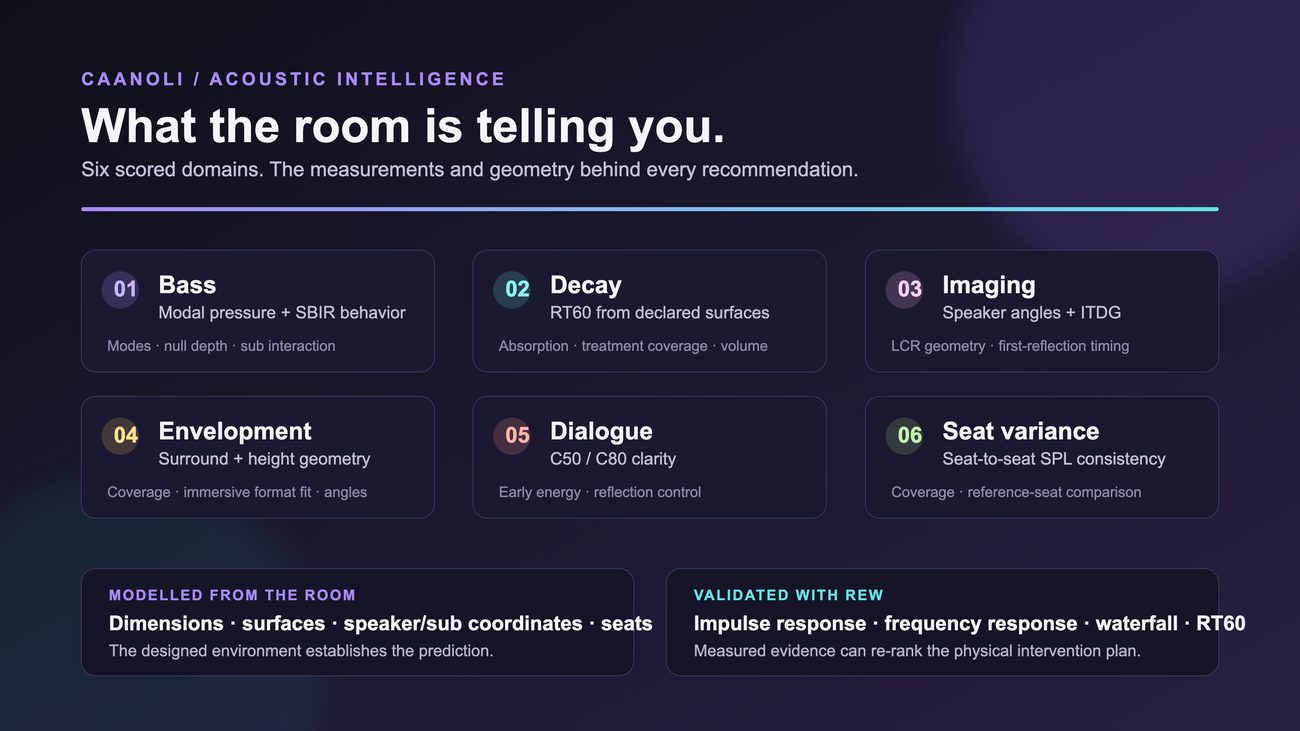
Every profile score is built from the same six physical measurements, just weighted differently depending on what the profile demands.
Bass
Low-frequency extension and how evenly it's distributed around the room.
Decay
How quickly reflected sound dies out.
Imaging
How precisely a sound source can be located in space.
Envelopment
How much the room's reflections wrap the listener versus leave the direct sound isolated.
Dialog
Midrange clarity and speech intelligibility.
Seat variance
How consistently the room performs across every seat, not just the best one.
The method
Model → Place → Measure → Verify
Model
Room geometry and materials become a physics model before anything is bought — this is where the nine predicted scores come from.
Place
Speakers, subs, and seats go where the model says they'll perform best, before any electronics get involved.
Measure
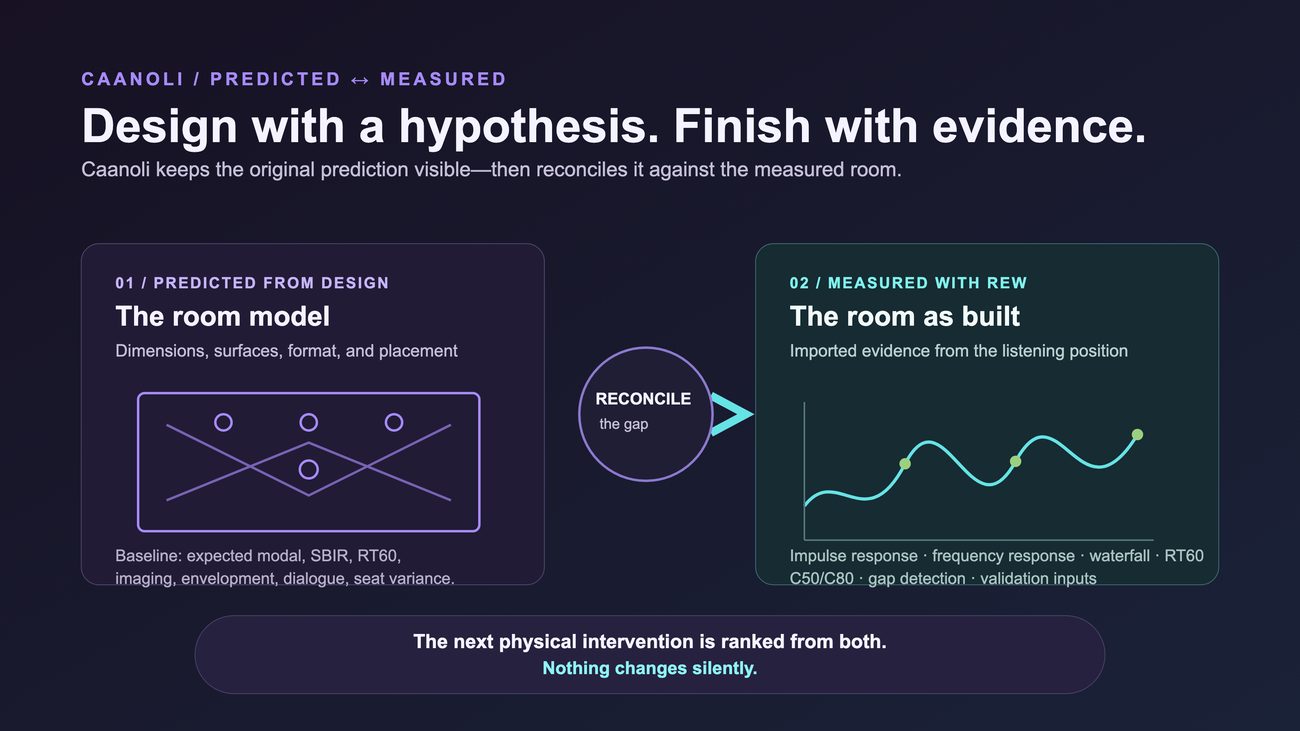
Once the room is built, REW measurement is taken and compared against the predicted model — a comparison, not a guess.
Verify
The predicted and measured results are reported together. Where they agree, the room performs as designed. Where they don't, the gap gets disclosed and explained — never smoothed over with EQ.
Predicted vs. measured
Stated plainly, not blurred together
A predicted score is a physics model's output — accurate to the geometry and materials it's given, but a prediction, not a guarantee. A measured score comes from real REW data taken in the finished room. The two can track closely, but not always. Different equipment, an unplanned change during install, or a detail the model didn't have can all open a gap. When that happens, caanoli reports the gap rather than hiding it.
Not every project runs the full pipeline. Some engagements are design-only and stop at predicted scores; others include on-site or remote-reviewed measurement and get both. Either way, a score is always labeled for what it is — predicted or measured — never presented as one when it's the other. The measured stage is where calibration comes in — on-site or remote, video, audio, and the room itself.
Questions
Scoring, plainly explained
What if my room doesn't match my declared profile?
It still gets scored against all nine — not just the one you declared. You see the full picture, including where the room happens to outperform what you designed it for, not just whether it hit the target you picked.
What's the difference between a predicted score and a measured score?
A predicted score comes from the physics model, before the room is built or anything is adjusted. A measured score comes from real REW measurement, after. When they disagree, that gap is reported and explained, not averaged away.
Why does caanoli fix the room before adjusting EQ?
EQ does not change the room's geometry, speaker placement, or reflections. It can help address parts of a response, but it cannot correct the physical cause of a null at a seat, bass buildup in a corner, or reflections that smear dialog. caanoli addresses physical causes first; EQ comes later, where it is useful.
Can one room score well for more than one profile?
Yes — most rooms score reasonably across several profiles at once. Very few score exceptional across all nine, because the physics that favors one use case sometimes works against another. The scoring shows that tradeoff honestly instead of hiding it behind a single number.